
Use your existing kiln space better.
Fit more timber into the same package envelope. Where drying is the bottleneck, improved filling can unlock capacity without adding kilns.
TeTrees measures each board, finds its place and builds optimized drying packages. Less manual stacking. Better use of the kiln space you already have.
PACKAGE FILL
20%+better package filling
Reference-site estimate
LABOUR SAVINGS
≈5.5employees: potential labour saving
Identified potential at the reference site
ENERGY SAVINGS
−16.7%fan electricity per m³
Calculated example at +20% filling
Same average electrical power drawn by the fans and drying time.
PACKAGE HANDLING
−16.7%equivalent package moves
Calculated at +20% filling
PACKAGE SPACE
6→5package positions for the same timber volume
Calculated at +20% filling
Reference estimates and calculated examples. Actual gains depend on the timber, installation and operating conditions. The calculated effects share the same filling improvement and must not be added together.
20%+ better filling is the reference production manager’s estimate with suitable input material. Approximately 5.5 employees is the identified labour-saving potential; the final staffing arrangement depends on the agreed automation scope and operating setup.
The calculations use exactly 20% more timber per package and unchanged package dimensions: 1 − 1/1.20 = 16.7%. Six original packages hold the same timber volume as five packages filled 20% better. Handling also assumes the same number of moves per package. Package positions do not represent the entire warehouse floor area.
The fan-electricity example assumes unchanged average electrical power drawn by the fans and drying time, with the required airflow and drying quality maintained. The same fan energy per cycle is spread over 20% more timber, reducing fan electricity per m³ by 16.7%. This figure does not describe total drying energy or a measured reduction in the electricity bill.
01 / THE BUSINESS CASE
The value continues through handling, drying and the daily work on your line. Where it matters most depends on your production.
Fit more timber into the same package envelope. Where drying is the bottleneck, improved filling can unlock capacity without adding kilns.
Automate board handling, layer building and drying-stick placement. The staffing impact is assessed against your current process.
Denser packages mean fewer package-handling operations for the same timber volume, and less pressure on internal logistics.
More timber per load can improve energy efficiency per m³. The actual saving depends on moisture, species and the drying schedule.
Automatic positioning between completed layers gives boards repeatable support and helps limit deformation during drying.
Combine irregular widths within defined package dimensions. Assign different stacking destinations to suitable production recipes.
02 / FROM BOARD TO PACKAGE
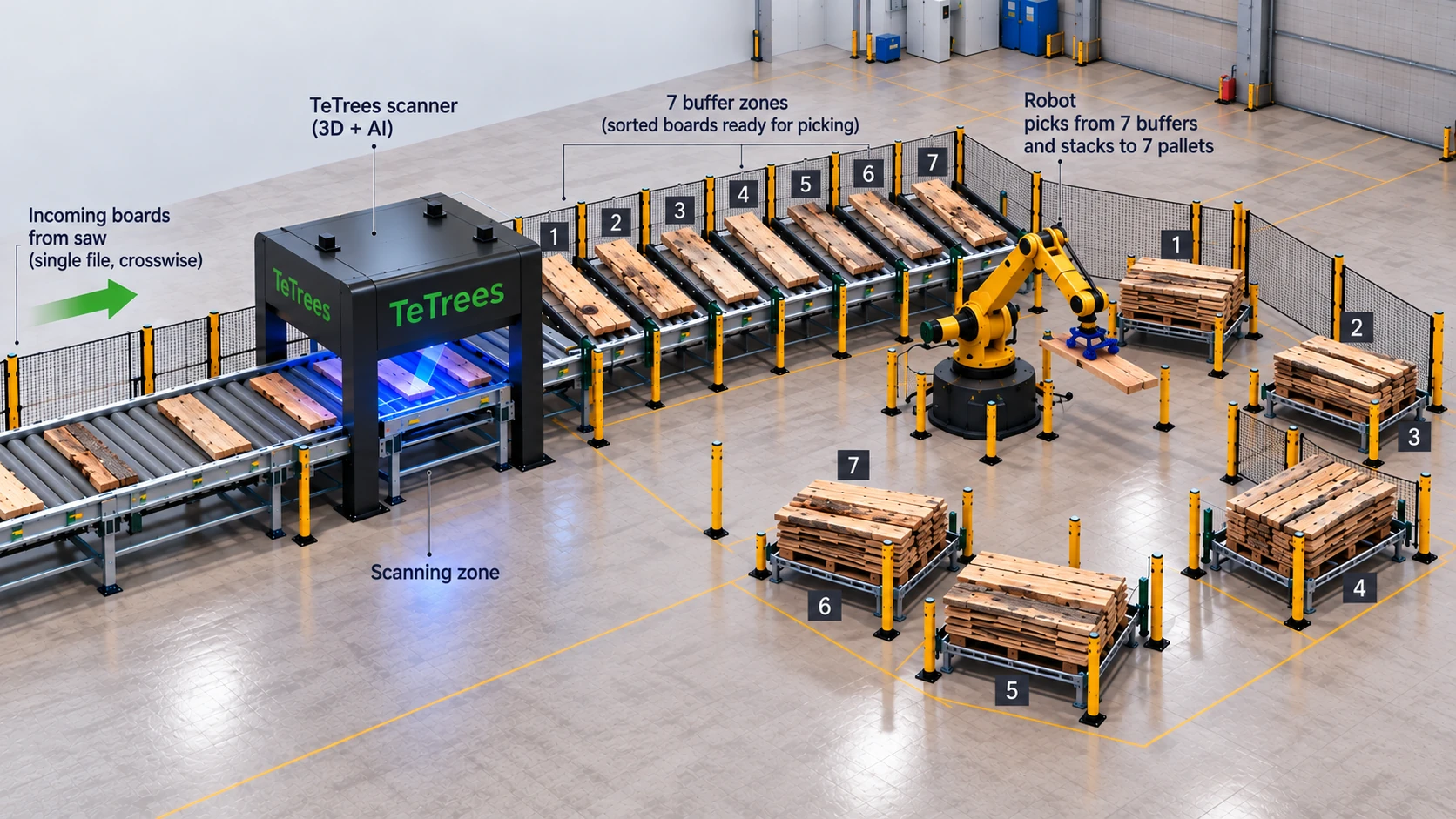
One integrated flow. Measurements inform the stacking decision; the robot executes the placement.
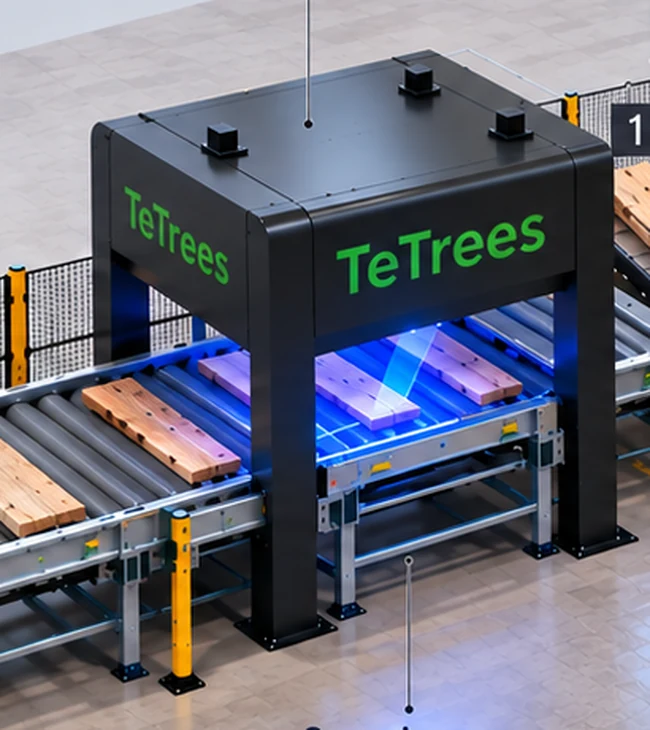 DETAIL FROM THE CONCEPT VISUALIZATION
Boards arrive from the saw and pass through the cleaning stage before measurement. The infeed and transfer arrangement are adapted to the existing line.
03 / IN OPERATION
See the operating installation at a Croatian sawmill. These are real production recordings, separate from the concept render above.
Ask about a reference visitVisits are arranged with the host sawmill and are subject to availability.
04 / THE PACKING EFFECT
Change the assumptions to explore the geometry of denser packages. These are illustrative inputs, not a forecast for your sawmill.
Timber in the same package envelope
3.60m³Equivalent package-handling reduction
16.7%for the same timber volumeThe two results describe different operating scenarios, not two savings to add together. Kiln throughput, energy use, labour and payback require a site-specific assessment. Drying performance and package constraints must be validated.
05 / BUILT AROUND YOUR LINE
TeTrees is an integrated production solution, not a one-size-fits-all machine. We start with your material, current stacking method and production constraints.
Computer vision and optimization by Trilobit. Mechanical and robotic integration developed with MOST for the reference installation.
No. Reducing manual stacking, improving package handling and placing drying sticks consistently may also be relevant. We assess the value against your actual bottlenecks, rather than assuming you need more drying capacity.
Stacking destinations can be assigned to different recipes, for example separate packages for different nominal thicknesses. Material ranges, tolerances and the effect on packing flexibility are defined for the project.
Not necessarily. The reference result is feedback from a specific production environment with suitable input material. Your starting point, board geometry, package limits and drying requirements determine the achievable improvement.
Potentially. We first review the available space, conveyor flow, cycle requirements and existing equipment with the machine builder. Integration scope is confirmed after a technical assessment.
LET’S START WITH YOUR PRODUCTION
Tell us what you process and where the line slows down. Board dimensions, a few photos and a short production video are a useful starting point.